“The Bangladesh you see now is no where near the same as it was ten years ago,” declared Dr. Masuma Khanam MBBS, a research investigator at the Center for Control of Chronic Diseases in Bangladesh (CCCDB). “The environment has changed drastically, and it is reflected in the people’s health.”
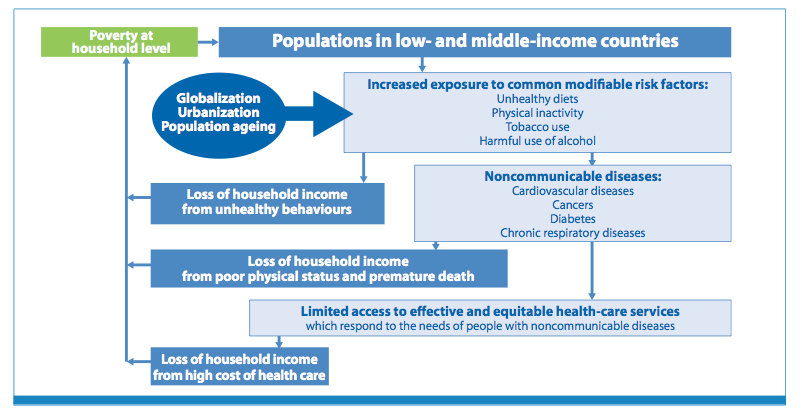
Previously—in similar accordance with other third-world, developing nations—the people of Bangladesh primarily suffered from a long-waged battle against infectious diseases, such as Cholera, Tuberculosis and Malaria. However, a combination of health strategies, globalization and modernization, has coupled with shifts in lifestyle to unveil new health concerns among the population. While successful health interventions have led to receding cases of infectious disease in Bangladesh, increasing trends of chronic non-communicable illnesses have been consistently observed. As of 2002, chronic diseases have accounted for nearly 50% of deaths in Bangladesh, a figure that is steadily escalating, and has generated a great deal of concern among Dr. Khanam and her colleagues at CCCDB for the growing population’s health. “If the situation persists as is, in the next five years, it will be really alarming for our country,” she ensures.
It was in response to this rising epidemic that CCCDB was first instituted in 2009 by several partner organizations, including: BRAC, International Centre for Diarrhoeal Disease Research, Bangladesh (ICDDR, B), Institute of Developmental Studies (IDS), and Johns Hopkins Bloomberg School of Public Health (JHSPH). Dr. Khanam has worked at the center alongside fellow physicians and researchers since its founding, conducting a series of studies focusing on hypertension and diabetes, two of the most prevalent chronic diseases currently plaguing the population of Bangladesh. Based on her findings, Dr. Khanam believes that the key to combating chronic non-communicable disease lies in using preventative measures. She points out that unlike infectious diseases, for which a majority of the time there exists a definite form of treatment or procedural remedy, chronic afflictions do not have a “cure” per se; rather, they rely on regulated therapies and/or lifestyle changes, which are costly and burdensome if left unattended. In the audio below, Dr. Khanam further discusses her thoughts on this issue:
By utilizing diagnostic techniques to identify patients or those who are high-risk, and following up with “lifestyle interventions”, such as awareness campaigns, information sessions and community learning programs, Dr. Khanam believes that we will be able to prevent such diseases from ever coming into full form—or at the very least, delay their progression.
However, before this is possible, she emphasizes that immediate action must take place in order to raise awareness, among lay peoples and healthcare professionals alike, of the threat of chronic diseases. By taking into account certain “risk factors”, researchers, health professionals and individuals themselves will be able assess where on the spectrum of susceptibility they lie, and what preemptive measures should be taken in response. Such risks include uncontrollable factors—age, environment and genetics—as well as modifiable factors—nutrition, physical fitness and tobacco use. While there is little that can be done to change the effects produced by the first category of risks, those of the latter group are very much within the realm of control for professionals and individuals. In fact, the World Health Organization (WHO) has named these last three categories—nutrition, physical fitness and tobacco use—as the primary points of intercepting chronic non-communicable diseases, leading Dr. Khanam to believe that these are where we should be focusing our efforts in Bangladesh, not only to prevent diabetes and hypertension, but all chronic illnesses: cardiovascular disease, cancer, chronic respiratory diseases, and others.
But as previously mentioned, raising awareness and providing knowledge constitute only a piece of the puzzle. Building up the necessary health infrastructures in Bangladesh will be no easy feat, and it will take several paradigm shifts in order to properly address these looming health threats. Most importantly, there must be a transition in the national mindset from one that is almost solely geared towards eradicating infectious disease, to one that is prepared to successfully handle chronic diseases. Furthermore, it will be necessary to create a systemized manner in order register current and potential patients, so that long-term assessments can be made. What Dr. Khanam is calling for is nothing short of a health revolution in Bangladesh.
Posted below are a series of interview questions and answers with Dr. Khanam as she further outlines a battle plan to tackle chronic disease in Bangladesh. First, she expands on the current status of chronic diseases in the country, discussing why it is imperative that these issues be addressed with the utmost haste. She then focuses on the primary barriers currently in place, which are inhibiting the realization of a healthcare structure that she would define as sufficiently equipped for the next generation of health concerns. Lastly, Dr. Khanam shares her thoughts on potential intervention strategies, speaking directly towards the Chronic Disease Community Health Modules currently being developed by the Public Health Sciences Division at ICDDR, B to be implemented in health clinics around Bangladesh.
Based on your observations and research, what is the current situation in Bangladesh regarding chronic diseases; why is it important that we address these issues?
| Chronic Disease in Bangladesh Today | Why It’s Important to Address Such Issues |
| -Demographic Transition has led to increased birthrates and lifestyle changes due to industrialization and modernization in Bangladesh.-Epidemiological Transition has led to successful maintenance of infectious diseases and decreased rates of child mortality Bangladesh.
-With a growing population and increased life expectancy, a higher percentage of the nation are now being affected by—or at risk for developing—Chronic Diseases, which have increased prevalence with age. |
-Healthcare Providers in Bangladesh have for a long time now been focused on infectious disease. Hospitals, researchers and physicians are ill-prepared—lacking supplies and infrastructure—for the imminent “wave” of chronic disease patients.
-While infectious disease may be remedied by a procedure or course of treatment, chronic diseases have no cure; they must be maintained and controlled, which is much more burdensome and expensive. |
What do you feel are some the greatest challenges to chronic disease treatment, and in general, creating sustainable healthcare systems, in Bangladesh?
|
Primary Challenges to Addressing Chronic Disease in Bangladesh |
|
|
Health Consumers |
Health Providers |
| -Raising awareness on basic models for “healthy lifestyles”— especially in rural areas with little access to information of health campaigns-Changing deeply rooted cultural and behavioral practices that have adverse effects on health (dietary habits, etc.) | -Refocusing the attention of healthcare professionals on chronic disease topics, so that they are able to follow guidelines, promoting accurate and relevant information to their patients.-Creating (centralized) registries and follow-up systems that ensure long-term care and evaluation of chronic disease patients. |
What can we be doing in order to meet these challenges to healthcare and reduce the burden of chronic diseases in Bangladesh?
|
Next Steps |
|
|
Short-Term |
Long-Term |
| -Creating community health modules that are culturally relevant and tap into local resources and health structures (e.g. community health clinics in Chakaria, Bangladesh). | -Look towards health models that have been successfully implemented in the developed world to lower chronic disease rates, and “twisting” them in a way that can flourish in the cultural context of Bangladesh. |
 Health 2 Heart