Early this week, I was given my official assignment to complete over the course of my next three months here in Bangladesh:
I will be collaborating with the Public Health Science Department here at ICDDR, B in order to design community health modules for chronic disease patients, which are to be implemented at the Centre for Control of Chronic Disease in Bangladesh (CCCDB). The modules are essentially workshops that will help educate patients on the features, risks and management of chronic diseases, namely: Diabetes, Hypertension (High Blood Pressure) and Cardiovascular Diseases.
I am really excited about it, and more than ready to take on the challenge!
_________________________________________________________________________________________
Below I have posted a brief introduction and proposal I have written up for the project:
According to reports published by the World Health Organization, chronic diseases, or non-communicable diseases, make up the world’s number-one killer, accounting for 60% of all deaths globally—80% of which occur in low and middle-income countries (1). Chronic non-communicable diseases are most often characterized as having “multiple risk factors, a long latency period, a prolonged course of illness, functional impairment or disability, and in most cases, the unlikelihood of cure,” which makes for complex medical cases (2). As such, these types of illness require a different approach to treatment—one that integrates economic, social and political sectors in order to build a framework of support through the illness. There is no procedure to do the trick; a change in lifestyle is required to maintain health.
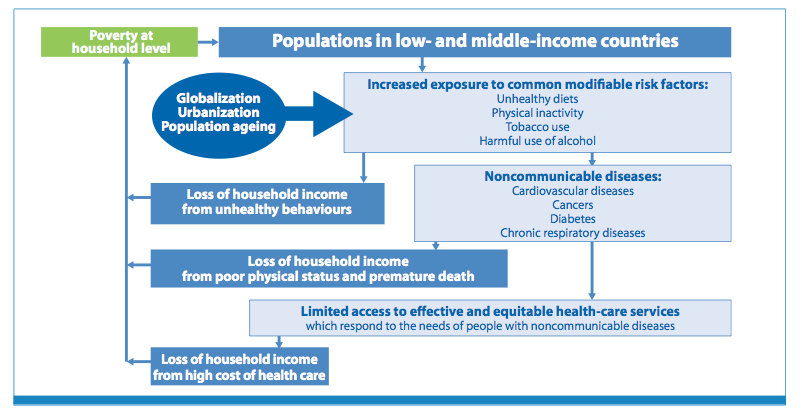
In Bangladesh, a low-income country residing in the Indian Subcontinent, rising trends in the number of chronic disease diagnoses have been observed, particularly in rural parts of the country where there is limited access to proper healthcare facilities and treatment. Among these emerging disease, the most prevalent are diabetes, hypertension and cardiovascular disease (3). In response to this epidemic, several organizations, such as CCCDRB, BRAC and the Hope Foundation have erected health clinics with the help of trained volunteer staff, where individuals can receive basic health services, as well as diagnostic tests such as blood sugar and blood pressure testing.
While a significant amount of patient data has been accrued, and the numbers of uncovered chronic disease diagnoses continue to increase, research indicates that there is a gap in the translation of data and research into practices that are being implemented into the community. In order to effectively tackle the threats to health posed by non-communicable disease, it is essential that sustainable health programs are put into effect in order to educate the people on general health and maintenance of chronic disease.
It has been noted by Glasgow and Emmons that health education and health programs must reach some threshold of intensity in order to achieve success; however, programs of too rigorous a design are likely to be unsustainable, as “few practice settings will have the resources of staff expertise required, and a relatively small and unrepresentative proportion of patients are likely to volunteer” (4). Instead, “minimal intensity” programs that are frequent and low cost may provide a better solution, especially taking into consideration low-income populations with limited educational opportunity and a lack of access to healthcare in general. The proposed modules are an attempt at designing a low cost, minimal-threshold health regimen that can be used by volunteer health workers in Bangladesh. The program will be designed to promote group activity and learning in order to better understand the nature of chronic illness, and work as a team to formulate a plan for behavioral changes based on the “5A” model (4):
- Asses: Determine beliefs, behavior and knowledge
- Advise: Provide specific information about health risk and benefits of change
- Agree: Collaboratively set goals on the basis of patients’ interests and confidence in their ability to change behavior
- Assist: Indentify personal barriers, strategies, problem-solving techniques and social/environmental support
- Arrange: Specify a plan for follow-up (phone calls, visits, (e)mail, etc.)
These volunteer-run health centers have great potential to become a source of health education for the community, promoting healthful self-regulating behaviors for individuals suffering from chronic diseases.
_________________________________________________________________________________________
WORKS CITED
(1) – World Health Organization. 2008-2013 Action Plan for the Global Strategy for the Prevention and Control of Noncommunicable Diseases (2008).
(2) – National Public Health Partnership. Preventing Chronic Diseases: A Strategic Framework. Rep. 2001.
(3) – International Center for Diarrhoeal Disease Research, Bangladesh. “Diabetes: The Emerging Epidemic in Bangladesh.” ICDDR,B Annual Report (2008): 7-10.
(4) – Glasgow, Russell E., and Karen M. Emmons. “How Can We Increase Translation of Research into Practice? Types of Evidence Needed.” Annual Review of Public Health 28.1 (2007): 413-33.
 Health 2 Heart